When a business is small or in its early stages, everything feels manageable. The founder knows everyone. Decisions happen quickly. Roles are flexible. Most things can be solved through a conversation, a phone call, or a WhatsApp message.
But growth changes the game.
Gradually, there are more employees, more teams, more leaders, more clients—and more things that can fall through the cracks. What worked when you had 5 people may not work when you have 50. And that doesn't mean what you did before was wrong. It means the business has evolved.
Many growing businesses delay formal HR processes because they believe:
- “We are not big enough yet.”
- “We will do it later on when we are ready.”
- “There is no problem with the way we are doing things.”
For established family businesses and next-generation leaders, there can be another layer to the conversation: “This is how we have always done it.”
There is value in protecting what has worked and brought the business to where it is today. At the same time, growth requires businesses to ask whether those same ways of working are still serving the organisation today. Because sometimes, the need for structure only becomes visible when the existing way of working starts creating friction.
“But We Don’t Have a Problem.”
This is one of the most common statements growing businesses make. And sometimes, they genuinely don't see a problem. The business is running. Clients are coming in. Employees are working.
But there is a more important question: are your people processes helping the business move forward—or are they simply keeping things running?
In a business environment where technology, work practices and employee expectations are changing rapidly, continuing with the assumption that “our people are fine” or “we don't need to change anything” can become a blind spot. Not every problem is immediately visible. Sometimes it looks like:
- A founder approving decisions that should already sit with a team leader.
- An employee who still isn't clear about their responsibilities after six months.
- A new hire learning the job entirely through trial and error.
- Two teams blaming each other because ownership was never defined.
- An employee wanting to raise a concern but not knowing whom to approach.
What may appear to be a people problem may actually be a process problem. And this is where structure becomes important.
Structure Is About Reducing Ambiguity
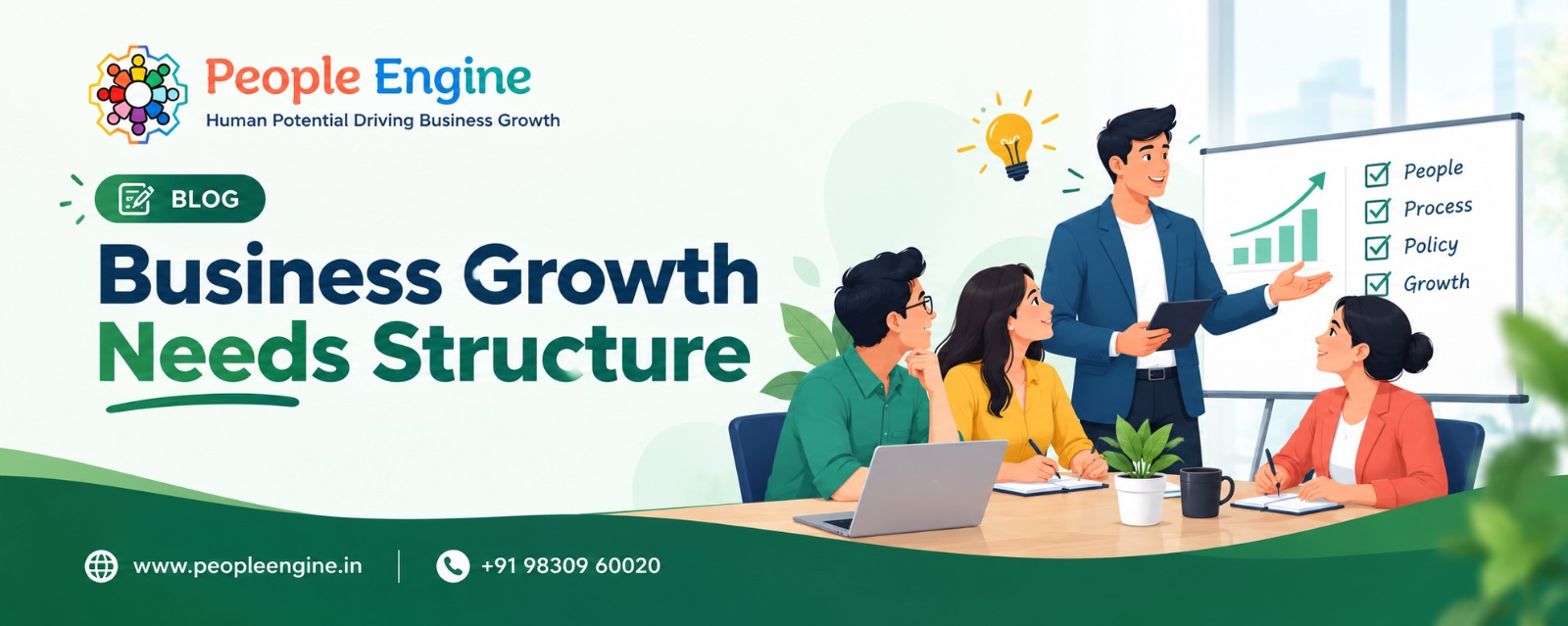
For a start-up or next-generation business leader, HR structure does not mean creating endless policies, forms and approvals. Structure is about reducing ambiguity.
Simple processes around roles, onboarding, performance, communication, leave, employee concerns and exits can make a significant difference. The objective is not to make the organisation rigid—it is to create enough structure for people to operate without constant supervision.
This becomes even more important as a business moves away from being entirely founder-driven. In the early stages, the founder often becomes the system. That may work when the business is small, but as the organisation grows, it can become a bottleneck.
The goal is to gradually move to clearly defined ownership, where people understand their responsibilities, managers have the authority to make appropriate decisions, and employees know where to go for support.
What worked then? What works now? And what will the business need next?
For next-generation business leaders, this does not mean rejecting everything that came before. Professionalising the people side of the business is not about changing everything—it is about building the right systems for the organisation's next stage.
Conclusion
You don't need 50 HR policies to get started. The goal is simple: build a business where people know what to do, managers know how to delegate, and the founder doesn't have to solve everything.
Because growth should not mean more people and more problems. It should mean better systems, clearer ownership and greater capacity to grow.
At People Engine, we help start-ups, growing businesses and next-generation business leaders build practical people systems that combine workplace psychology, HR processes and behavioural insights. HR should be about creating the clarity, accountability and structure that help your people—and your business—grow.