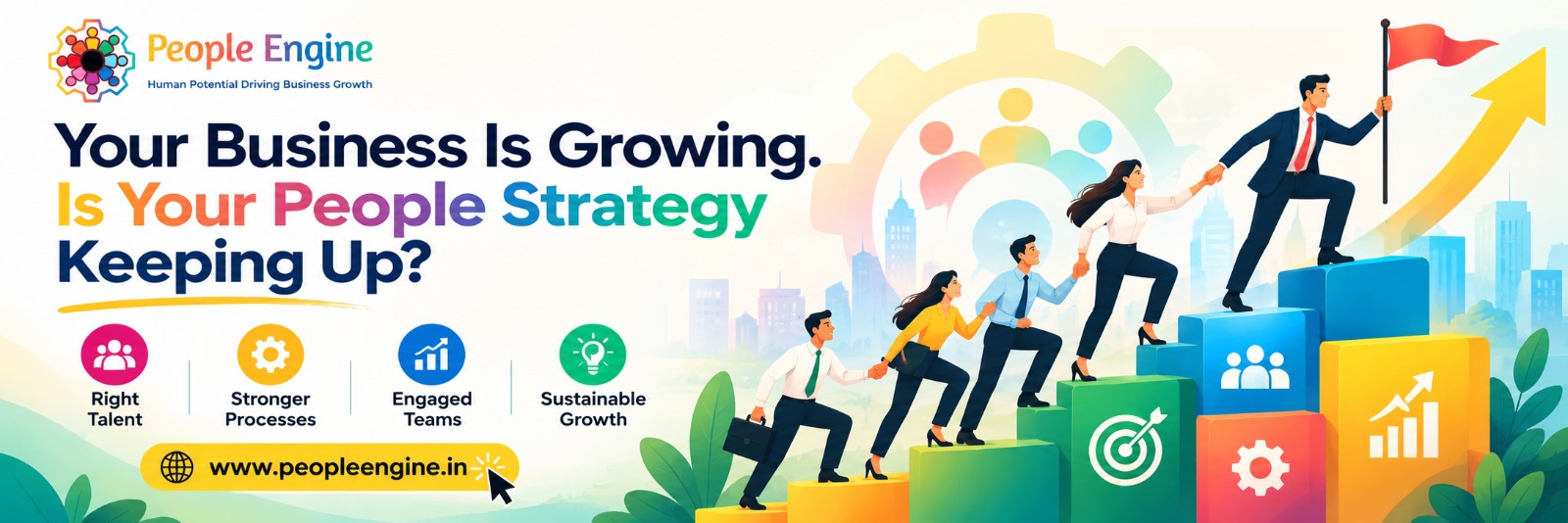
Growing a business is exciting. More clients, more revenue, a bigger team, and new opportunities are all signs that the business is moving forward.
But growth also changes the way a business needs to operate.
When a team is small, most things happen naturally. People know whom to approach, responsibilities are flexible, and decisions can be made through a quick conversation.
But as the business grows, things become more complicated.
Roles start overlapping. Managers struggle to manage larger teams. Hiring becomes urgent rather than planned. And the systems that once worked well begin to show their limitations.
What worked when you had five people may not work when you have fifty.
And that doesn’t mean what you did before was wrong. It means the business has evolved.
When Growth Starts Creating Friction
Many growing businesses focus on sales, operations, and expansion while assuming that their people processes will fall into place along the way.
But they don’t always.
Sometimes, the challenges become visible only when they start affecting everyday work. A few examples:
- Two employees handling the same task because ownership was never clearly defined.
- A high-performing employee promoted to manager but struggling to lead a team.
- Hiring that begins only when someone resigns or the workload becomes unmanageable.
- Employees who want to grow but don’t know what their future in the organisation looks like.
- Founders still approving decisions that should already sit with their managers.
Individually, these may seem like small issues. But as the business grows, they can affect productivity, employee engagement, and the ability to scale effectively.
And often, what appears to be a people problem is actually a problem with the way the organisation is structured.
Growth Requires More Than Hiring
When a business expands, adding more people is only one part of the equation. The organisation also needs to think about how those people will work together.
Are roles and responsibilities clear? Do managers know how to delegate? Is there a process for setting expectations and reviewing performance? Do employees understand how they can grow within the business?
These questions become increasingly important as the organisation moves away from being entirely founder-driven.
The objective is not to introduce complicated HR systems or create policies for everything. It is to put the right foundations in place.
Clear roles, structured onboarding, consistent performance reviews, practical workplace policies, and managers who know how to lead can make a significant difference. These systems help people work with greater clarity and reduce the need for constant intervention from the founder.
Your People Strategy Should Grow With Your Business
For start-ups, SMEs, and family businesses, building a stronger people strategy does not mean changing everything that has worked so far. It means recognising what the next stage of growth will require.
A business with ten employees may need clearer roles and responsibilities. A business with fifty employees may need stronger management practices, structured performance systems, and more consistent HR processes.
The requirements will differ, but the underlying objective remains the same: creating an organisation where people can perform well without everything depending on the founder.
You don’t need to build every system at once. Start by identifying where the current way of working is creating confusion, delays, or unnecessary dependence on a few individuals. Then focus on the changes that will make the biggest difference.
Because the goal is not simply to build a bigger team. It is to build an organisation that can grow without making everyday work more difficult.
At People Engine, we help start-ups, growing businesses, and family business leaders build practical people systems that combine workplace psychology, HR processes, and behavioural insights.
Growth should create greater capacity, clearer ownership, and better ways of working—not more people problems.